How to Declutter Your Home: A Guide for People Who Don’t Know Where to Start
The hardest part of decluttering isn’t getting rid of things. It’s figuring out where to begin when the whole house feels like too much, when every room is a decision, when you’ve started before and ended up surrounded by piles that somehow got put back.
This guide is for that version of the problem. It doesn’t assume you have a free weekend, an empty spare room to stage a sorting operation in, or the emotional bandwidth to tackle a lifetime of accumulated objects in one sitting. It assumes you have a home that feels heavier than it should, and a vague sense that getting lighter would help.
These are the principles and places to start that have actually worked — for people who live in small spaces, busy households, homes shared with people who aren’t on board, and for anyone who has tried the big dramatic declutter and found themselves back where they started six months later.
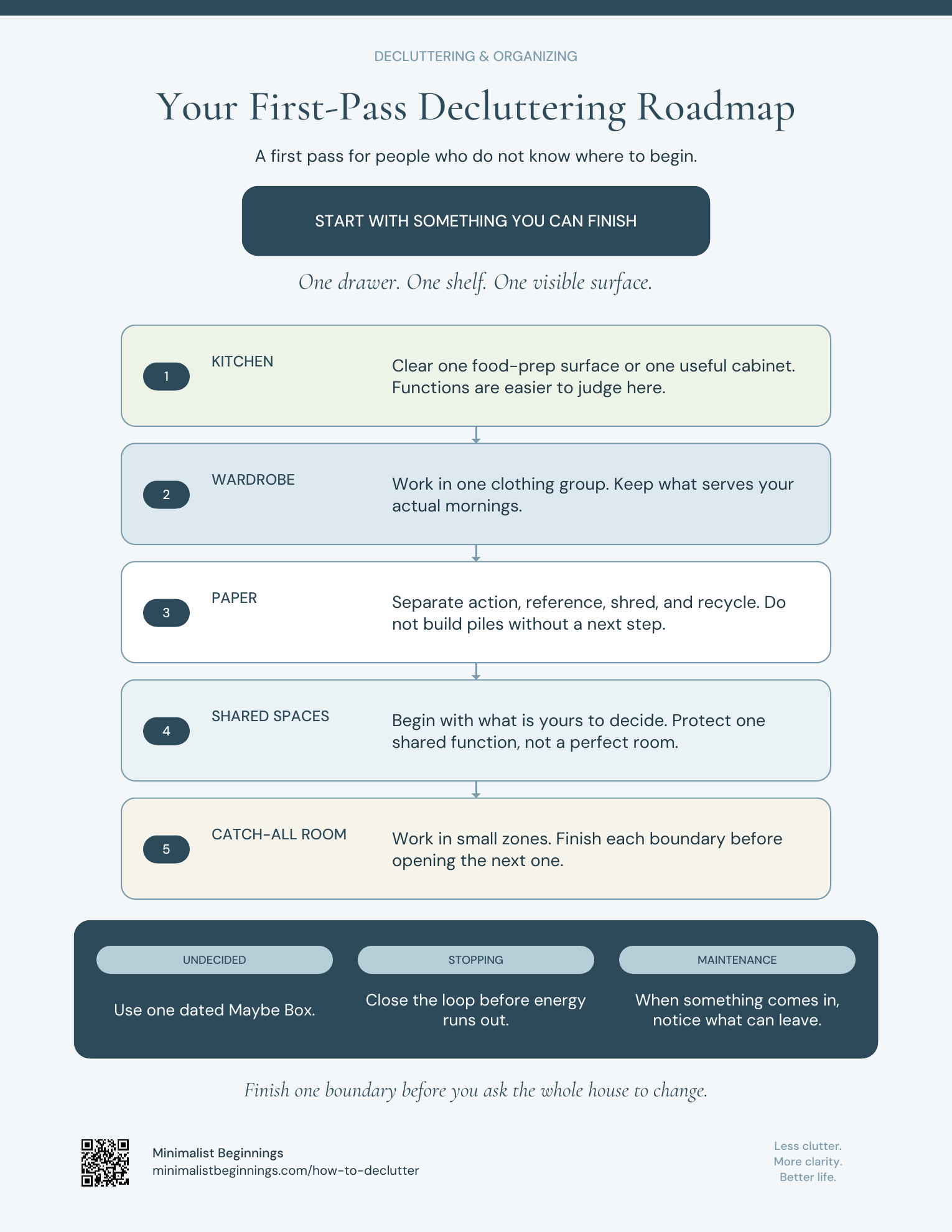
You don’t need a free Saturday and a van to donate to. You need one drawer and twenty minutes.
The single rule that makes decluttering actually work
Most decluttering advice tells you to start with the easiest things first, or the most cluttered room, or the category you care least about. That’s all reasonable. But the most important rule is simpler: start with something you can finish.
Not a room. Not a category. One container, one shelf, one surface. The whole point of starting small isn’t to be timid — it’s to build the specific experience of finishing. A finished drawer feels different from an improved drawer. Finishing creates momentum in a way that improvement doesn’t.
The one-drawer rule is the cleanest version of this: pick one drawer, finish it completely, and leave it alone. Don’t move on to a second drawer the same day. Let the finished one sit and notice how it feels to have one small part of your home genuinely resolved.When you’re ready to build on that, the easiest thing to declutter first gives you a sequence to follow — starting with the categories that require the least emotional energy, saving the harder ones for when you have more practice and more conviction.
How to handle the things you can’t decide about
Every decluttering project has two populations: the things you know you’re keeping and the things you know you’re letting go. Those are easy. The hard population is the third one: the things you can’t decide about. The things you don’t love but feel guilty releasing, the things that might be useful someday, the things that belonged to someone you’ve lost.
Trying to make every decision in one session can become tiring and leave the project stalled. The guide to why decluttering feels hard explains the memory, waste, and identity underneath that fatigue. A better approach is to separate the decision from the deadline.
- The maybe box is a physical holding pen for things you can’t decide about yet. You seal it, date it thirty days out, and store it somewhere out of the way. If you haven’t opened it by that date, the decision has largely made itself.
- For objects with emotional weight — inherited things, gifts, items connected to relationships — the pace is different. Decluttering sentimental items without guilt is about giving that category the slower, more considered attention it actually deserves.
- If the whole project feels like too much before you even begin, how to start decluttering when you’re overwhelmed addresses the specific version of paralysis that comes from not knowing where to look first.
Room-by-room: where to focus
Once you have a process, the question becomes where to apply it. Different rooms have different dynamics. Some are heavy with decisions; others are full of straightforward objects that are easy to triage once you give them attention.
A few places to start, roughly in order of difficulty:
- Kitchen. The kitchen is one of the best rooms to start with, because most kitchen objects have clear functions. Something is either useful in your actual cooking life, or it isn’t. There’s less emotional weight than a closet or a storage room, and the results are immediately visible every time you cook. How to declutter your kitchen works through this room methodically without requiring you to empty every cabinet at once.
- Wardrobe. Clothing feels personal, which makes it harder, but it’s also one of the areas where decluttering has the most daily impact. A wardrobe that only contains things you actually wear is genuinely easier to use every morning. Decluttering your wardrobe without starting over takes a gradual approach that doesn’t require you to pull everything out and make forty decisions in an afternoon.
- Paper. Paper is one of the sneakiest clutter categories because it keeps arriving. Most people have years of paper they’ve held onto because getting rid of it felt risky. The paper problem covers how to let go of documents you’ve been avoiding and build a system that keeps paper from accumulating again.
- Shared spaces. Rooms that two people share require a different approach than rooms that are entirely yours. If you share a home with someone who isn’t interested in decluttering, there’s a workable path forward that doesn’t require their participation or their buy-in. Decluttering when you live with someone who doesn’t starts with what’s actually yours to do.
- The catch-all room. Most homes have one room that gradually became a dumping ground — the spare room, the office corner, the basement. These are often the most daunting because the accumulation reflects years of deferred decisions. How to reset a room that became a dumping ground approaches it as a staged process rather than a single overwhelming project.
Stopping the clutter from coming back
Decluttering once isn’t a permanent fix. Clutter is a flow problem, not a one-time accumulation problem. Things keep coming in — purchases, gifts, objects that migrate from one room to another — and without a system for managing that flow, the cleared space fills back up.
The most effective mechanism is also the simplest: the one-in one-out rule. When something new comes in, something else leaves. It doesn’t require you to become a strict minimalist or to count your possessions. It requires only that you notice the flow. The one-in one-out rule explains how to apply it to different categories — clothing, books, kitchen equipment — in a way that sticks without feeling like a system you have to maintain.
For the deeper question of why homes tend to fill back up even after a thorough declutter, the real reason your home gets cluttered again gets at the behavioral patterns that most decluttering guides skip over.
If you want to connect this clear-out with how you live afterward, the beginner guide to minimalism offers a broader starting framework.
One thing to do today
If you’ve read this and you want to start, start with one drawer. Not a room, not a category — one drawer. Set a twenty-minute timer. Take everything out, wipe the bottom, and put back only what belongs there and what you actually use. When the timer goes off, you’re done for today.
That’s enough. One finished thing, practiced consistently, changes the feel of a home more than a big weekend effort that leaves everyone exhausted and half-finished piles on every surface.
Come back to this page when you’re ready for the next one.
Understanding Why It’s Hard
- How to Declutter When You’re Emotionally Attached — the real reason you keep avoiding it, and how to work with it
Browse all decluttering & organizing posts or go back to all posts.