How to Use a Maybe Box for Decluttering
You pick up an unused camera, then put it back. It still works, and the memory card needs attention. A yes-or-no decision feels premature.
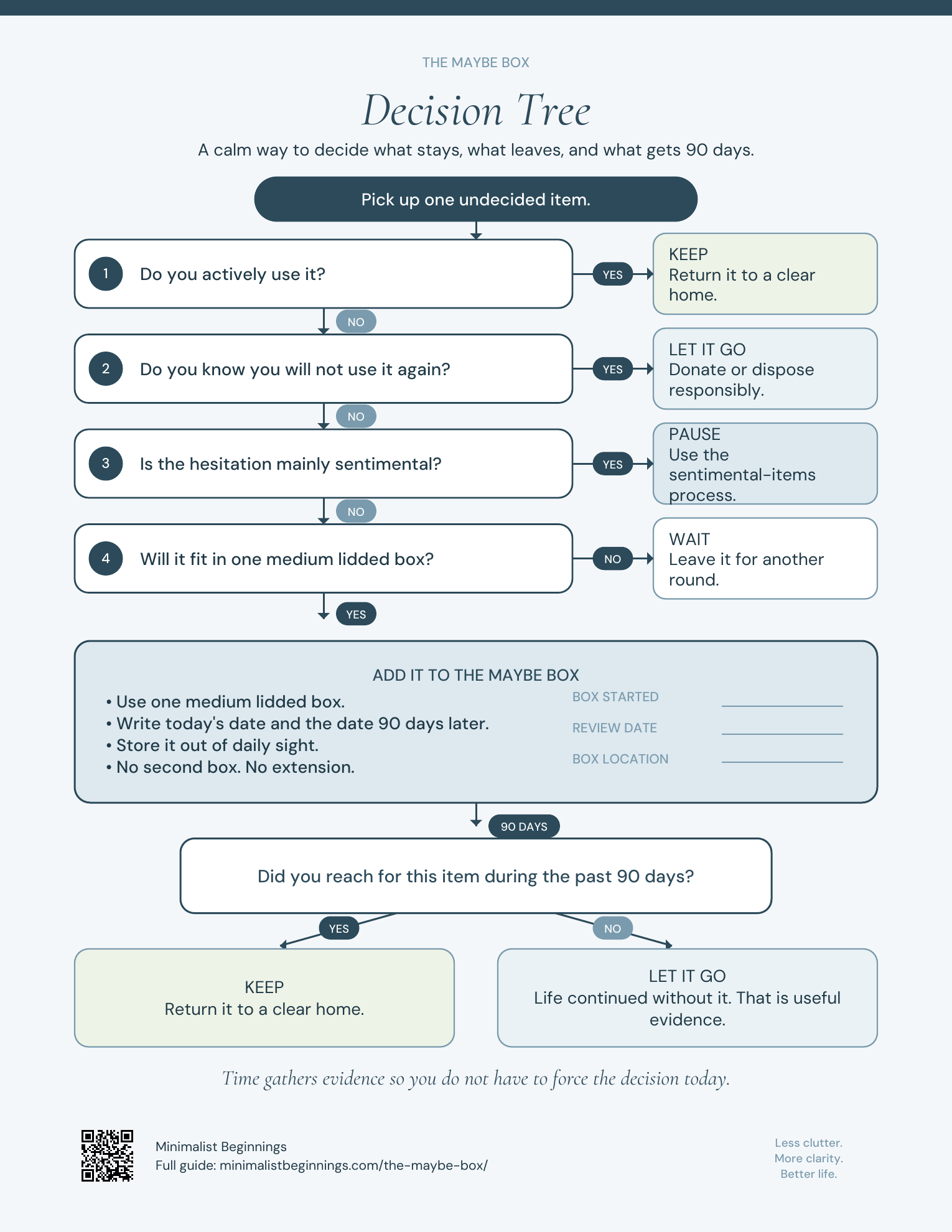
A Maybe Box holds undecided everyday belongings in one container for 90 days. Set a review date, notice what you need, then open the box and check every item before deciding what stays.
Download the free one-page Maybe Box decision tree (PDF).
The box gives a decision a boundary. It does not make the decision for you.
Choose one box and a review date
The Maybe Box is a single box — cardboard works fine — where you place the items you cannot make a clean decision about. You label it with today’s date, close it, and put it somewhere out of the way. Top of a closet. A corner of the basement. Somewhere you won’t bump into it daily or feel tempted to rummage through it between now and the check-in.
Then you leave it alone for 90 days.
That’s the full method. A box, a date, a waiting period. No spreadsheet required. No inventory system. No weekend sorting project.
Keep this a contained decision process. At the review date, open the box and consider each item. A clear need earns a place at home. An item you no longer need gets a suitable destination. Anything requiring information gets one named follow-up, rather than another unexamined 90-day cycle.
The constraint that makes it work is its size. The box should be medium — a standard banker’s box is ideal. Big enough for a handful of meaningful items, small enough that you can’t treat it as overflow storage. If something won’t fit, it doesn’t go in. That’s a feature, not a limitation. The act of deciding whether something is worth a spot in the box is a small, lower-stakes version of the decision you’re not ready to make yet.
The one in, one out rule helps manage new additions after you have enough. The Maybe Box handles a different decision: belongings already at home whose usefulness remains unclear.
Put everyday uncertainties inside; keep essentials out
You need a box, a marker, and a date.
Get one box with a lid — not a bag, not a drawer. Write today’s date on the outside in large numbers. If you want to be explicit about it, write the check-in date too: 90 days from now.
Now walk through the area you’re working on and place in anything that meets both conditions: you can’t immediately decide to keep it, and you can’t immediately decide to let it go. The gray zone. The things you’ve been moving from one surface to another without resolving.
A few things that don’t belong in the Maybe Box:
- Active essentials: keep medication, safety equipment, keys, and items you depend on accessible.
- Seasonal belongings: a winter coat unused through summer has not had a fair test. Review it after its relevant season.
- Important records: keep identity, tax, legal, warranty, and other essential documents in their filing system. Follow the retention requirements that apply to them.
- Other people’s belongings: ask the owner. This box is for decisions you are entitled to make.
- Devices and personal data: back up what you need and verify the backup before erasing or donating. Follow the manufacturer’s reset instructions for that device.
- Sentimental items: give grief, gifts, and family history separate attention. Decluttering sentimental items without guilt offers a gentler process.
Items you already know can leave do not need a waiting period. Check condition and find an appropriate recipient or disposal route. A donation box is for things someone can use.
One box, one 90-day period. If you fill the box and there are still undecided items left over, they stay where they are and wait for a future round. The goal is not to clear the whole room in one pass — it’s to create a structured way for time to do part of the work for you.
Open the box and review every item
When the date arrives, take the box to a well-lit room and open it.
Go through each item and ask one question: Did I reach for this at any point in the last three months? Not “could I imagine needing this someday?” Not “might this be useful if the situation changed?” — only: did I actually want it and find it missing?
If you did not need it, consider letting it go after checking ownership, condition, seasonality, and personal information. Open the whole box and handle each item. Forgetting its contents is useful information, but it is not a reason to donate the box unchecked.
If yes: the item goes back. It earned its spot.
The question is deliberately narrow because it is easy to imagine a future situation where any item becomes useful. That gets harder when you are tired and standing in a half-cleared room. The 90-day window gives you something concrete to consider: you lived without this for three months. What happened?
A worked example: September 5 to December 4
This is an illustrative example, not a reader case study. On September 5, 2026, a household puts three undecided items in a box: a spare vase, a travel mug, and an unused camera. The label reads “Review December 4, 2026,” which is 90 days later.
In October, someone needs the mug for a regular commute. They take it out and give it a place beside the kettle. Retrieving something is allowed; useful evidence matters more than keeping the box sealed.
On December 4, they check the remaining items. The clean, undamaged vase goes to a local recipient who accepts it. The camera waits for a specific task: copy the photographs, verify they open, and remove personal data. Only then is it ready to pass on.
The result is one item kept, one released, and one with a defined follow-up. That is a completed review, even though the box did not go straight to donation.
Why keep-or-donate breaks down for some things
The standard decluttering method — hold each item, decide keep or donate, move on — works cleanly for obvious cases. The pants that haven’t fit in three years. The third spatula. The book you read once and won’t read again.
It stalls on the gray-zone items. These are things with some residual claim on you: emotional weight, unclear utility, or the quiet guilt of not using something expensive. Looking at them while tired in a half-cleared room may not be the moment for your clearest decision.
The problem is that you’re deciding under uncertainty. You don’t know if you’ll need this in six months. You don’t know how you’ll feel about it later. So you hedge. Back on the shelf. And the shelf doesn’t change.
The Maybe Box shifts the frame. Instead of deciding under uncertainty, you’re buying time to let reality weigh in. Did you reach for this? Did its absence cause any problem? That’s information you don’t have in the moment. Ninety days from now, you have it — and it’s real, not hypothetical.
The box may empty, or a few items may return to use. Either result tells you more than repeatedly moving the same belongings around a shelf. The aim is a considered decision, not the largest possible donation.
If you’re starting a larger declutter and the idea of making every decision right now feels like too much, this approach takes some pressure off the early passes. There’s a related approach in the post on how to start when you’re overwhelmed — the same instinct applies: you don’t have to sort everything at once, and lowering the stakes on the first pass makes it easier to start at all.
One thing to try this week
Find a box — cardboard, with a lid, medium-sized. Label it with today’s date and a review date 90 days later.
Walk through one room and place in the three to five items you’ve been moving around without deciding on. Not the obvious keeps, not the obvious donations — the ones you set down and pick up again without resolution.
Close the box. Put it somewhere out of the way. Set a calendar reminder for 90 days from now.
Then leave it. Let the time do what standing in the closet with the item in your hands never quite can.
Related, when the hard things pile up: how to declutter sentimental items without guilt and how to declutter when you’re emotionally attached.
The maybe box works best as part of a larger decluttering process — the guide to decluttering your home puts it in context.
Browse all decluttering posts or go back to all posts.