How to Start Decluttering When You’re Overwhelmed
I have stood in the middle of a cluttered room holding one object and feeling responsible for all of it.
The laundry on the chair. The papers on the table. The box I had not opened since the last move. Every item seemed to ask a different question, and I did not have enough attention to answer any of them.
That is the part many decluttering plans miss. When you are overwhelmed, you may not need a larger plan. You need a beginning small enough that it does not feel like another demand.
The goal of your first session is not a finished room. It is one visible area that asks less of you than it did ten minutes earlier.
You are not clearing the house today. You are making the next ten minutes easier to enter.
Begin with one visible ten-minute reset
Choose an area no larger than a bath towel: one chair, one section of counter, the top of a nightstand, or the space directly inside a doorway. Avoid drawers for this first round if opening one is likely to reveal another hidden project. A visible surface gives you a result you can see without searching for it.
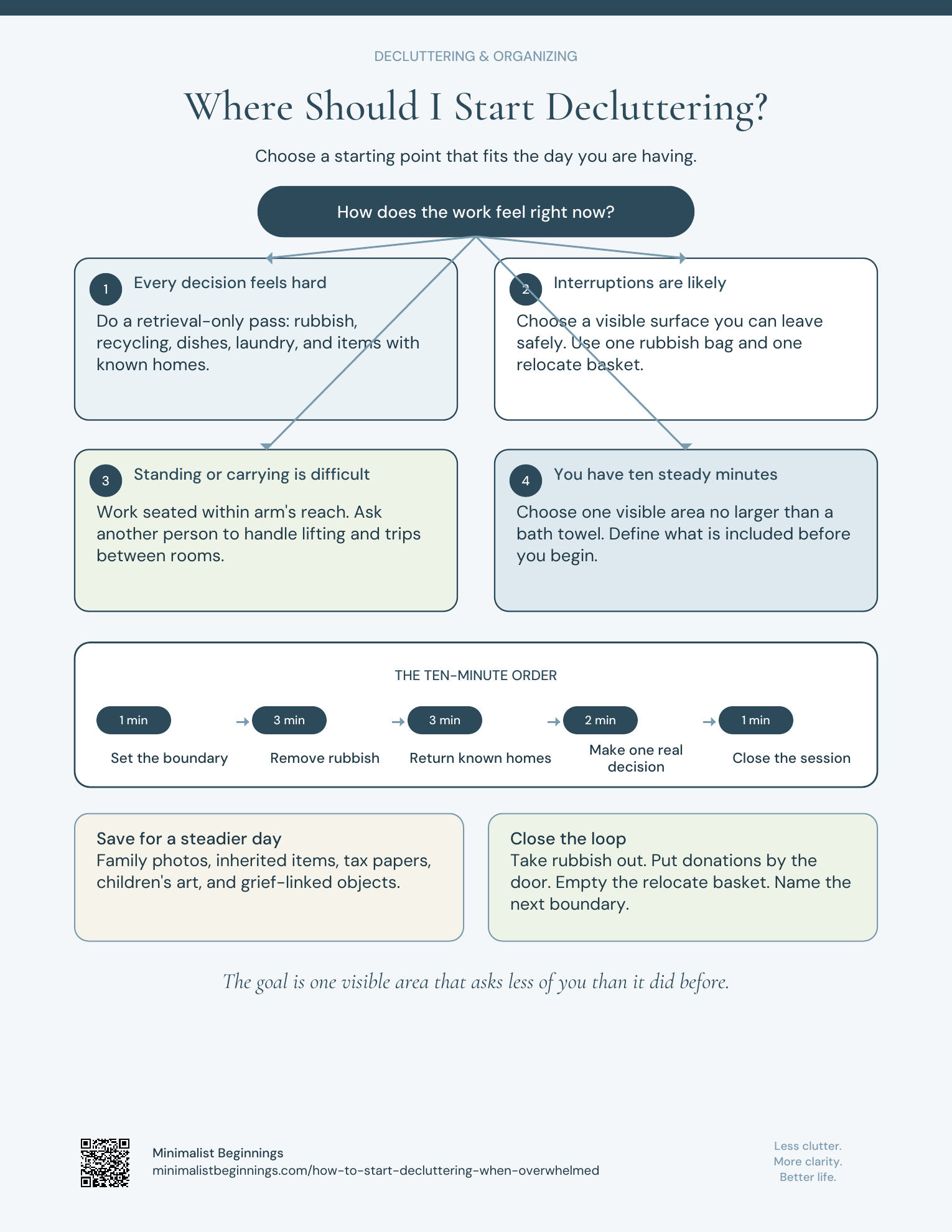
Set a timer for ten minutes. Use the time in this order:
- Minute one: choose the boundary. Say what is included and what is not. The left half of the counter counts. The rest of the kitchen does not.
- Minutes two through four: remove rubbish and recycling. Empty packaging, expired notices, broken objects, and anything you already know has no further use can leave without a long decision.
- Minutes five through seven: return items with known homes. Carry the mug to the kitchen. Put the book on its shelf. Hang the coat. Do not reorganize those destinations.
- Minutes eight and nine: make one real decision. Choose one object you have been avoiding and decide whether it stays, leaves, or needs more time.
- Minute ten: close the session. Put the donation item by the door, take the rubbish out, and leave the cleared boundary visible.
If the timer ends before the surface is clear, stop anyway. A contained session teaches you that decluttering has an exit. That matters when previous attempts have taken over a whole day.
Keep the first boundary visible for the rest of the day. Do not fill it with the next sorting pile. Seeing an open section of counter while you make dinner gives the work a purpose beyond counting bags. The room has begun to function differently, even though most of it has not changed yet.
Choose the version that fits your capacity today
Ten minutes is not a test. Change the method to fit the day you are having.
When your energy is low
Sit down and work within arm’s reach. A bedside table, one bag, or the papers beside your chair is enough. Make two groups: belongs here and belongs elsewhere. Leave the second group in a basket for a higher-energy hour. You still reduced the decisions in front of you.
When you expect interruptions
Choose a surface you can leave safely at any moment. Do not empty a closet or tip a container onto the floor. Keep one bag for rubbish and one basket for items that belong elsewhere. If someone needs you after four minutes, the room is no harder to use than it was before.
When every decision feels difficult
Make the first session retrieval-only. Remove rubbish, dishes, laundry, and objects with an obvious home. Skip sentimental belongings, paperwork, photographs, and items tied to money. You are allowed to improve the room without answering its hardest questions.
When reaching or carrying is difficult
Work from a stable seated position and ask another person to handle lifting or trips between rooms. Pointing, naming, and deciding are still the work. A method that respects your body is not a lesser version of decluttering.
Keep the hardest categories out of the first session
The first ten minutes should not begin with family photographs, inherited belongings, tax papers, children’s art, or anything connected to grief. Those categories deserve time and steadiness. They also explain part of why decluttering feels hard: the object may be carrying memory, money, or identity. Starting there can make the entire home feel emotionally loaded.
Begin with low-history objects instead:
- Empty containers and obvious rubbish
- Duplicate utensils or toiletries
- Expired food or medicine, disposed of safely
- Clothes waiting to be washed or put away
- Objects that already have a known home
If an item stops you, place it in a small pause box and keep moving. Write a review date 90 days away on the box. At that review, open it and check every item before deciding what leaves. Keep essential records, seasonal needs, and other people’s belongings out of this timed test. The Maybe Box method gives uncertain belongings a boundary without forcing an answer while you are tired.
Keep the pause box small. It is a temporary home for a few difficult decisions, not a second storage system. When it is full, the next step is to review what is already inside rather than beginning another box.
If the room is connected to bereavement, trauma, unsafe living conditions, or conflict at home, clearing it may need support beyond an article. Move at a pace that feels safe and ask for practical or professional help when the situation calls for it.
Use one decision tree instead of starting a new debate
For each ordinary object, move through these questions in order. Stop when you reach an answer.
- Is this rubbish, recycling, or unsafe to keep? If yes, let it leave.
- Does it have a home elsewhere in this house? If yes, return it.
- Have I used it, needed it, or chosen it on purpose within the past year? If yes, keep it and give it a clear home.
- Would more time make this decision kinder or clearer? If yes, place it in the pause box. If no, let it go.
You can print those four questions or write them on an index card. The wording matters less than using the same order. A repeated sequence reduces the number of new arguments you have to invent for every object.
Do not buy storage during this stage. A basket can make a crowded shelf look quieter while preserving every decision underneath it. Decide what remains first. Give the remaining objects homes afterward.
When several useful objects have no home, write them down instead of moving them from surface to surface. That short list becomes an organizing task for another day. Separating the decision about what stays from the decision about where it lives keeps one uncertain shelf from taking over the session.
If even a drawer feels too large today, the same-surface rule keeps the work on one visible area.
If choosing the first move is the obstacle, make three starting decisions: where to work, how long to stay, and what counts as done.
Leave the room easier to restart
A good stopping point is not the moment you run out of energy. Stop while you still have enough attention to close the loop.
Take the rubbish out. Put donations in the car or beside the door. Return your empty basket. Write down the next small boundary: the right half of the counter, the second chair, the top drawer. When you return, you will not have to decide where to begin again.
If you want a wider plan after this first reset, use the guide to decluttering your home. If a single contained boundary feels better, continue with the One-Drawer Rule. Both sit inside the broader Decluttering & Organizing hub.
For today, choose one surface and ten minutes. Leave one small patch of relief where you can see it.