How to Declutter One Drawer and Finish It
A drawer catches on its contents again. You wanted a pair of scissors, and now the whole kitchen feels like a project.
The one-drawer rule means choosing one drawer, sorting what belongs there, and finishing that contained space. Keep the other drawers closed, and leave time to put things away before you stop.
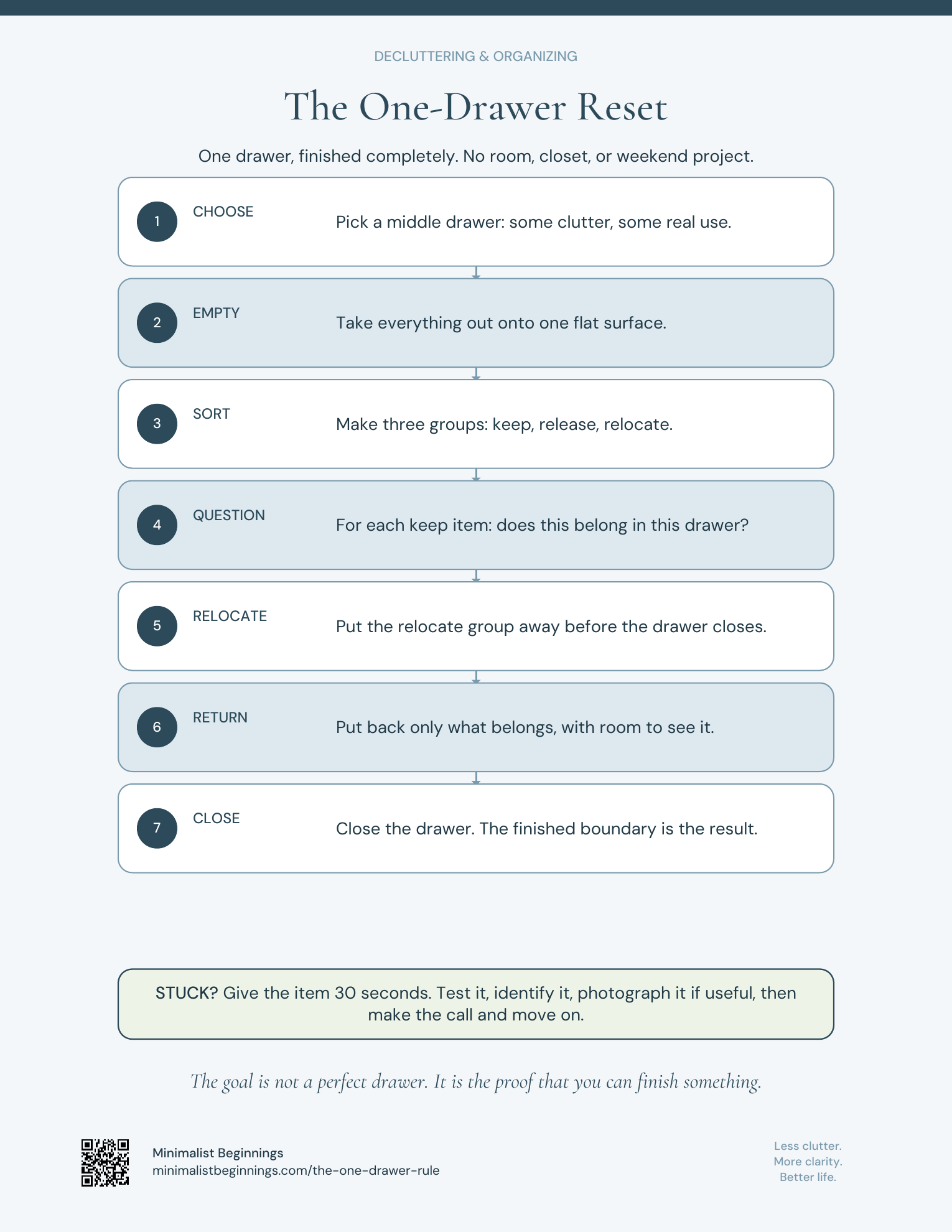
Download the free one-page One-Drawer Reset guide (PDF).
A drawer that works is enough for today.
Choose a drawer you can comfortably reach
Most advice about decluttering moves toward scale. Clear out a whole room. Dedicate a weekend. Do it all at once so you can feel the difference immediately. There is a version of this advice that works for some people, and it is a version I respect.
But a large starting point can make beginning harder when your time or energy is limited.
The problem with a large project is not always the work. It is the number of decisions presented at once. When you open a closet and face hundreds of choices, closing the door can feel easier than finding a place to begin.
A drawer offers a visible boundary. Choose an easy one if that is what fits today. Avoid lifting a heavy drawer or spreading its contents across a walkway. A table, tray, or clear counter at a comfortable height gives you a safer place to work.
The goal is a useful finish, with fewer loose ends. You do not have to learn a lesson from the hardest drawer first. A cutlery drawer with obvious decisions is a reasonable beginning.
Sort into keep, release, and relocate
Pick one drawer and name its job: everyday cutlery, desk supplies, or keys and small items near the door. That job becomes the test for what returns.
If you have enough space and energy, empty the drawer onto a clear surface. For a seated or lower-energy version, leave the drawer in place and move five items at a time onto a tray. You can finish one section today without emptying the whole drawer.
Sort into three groups: keep, release, and relocate. Keep means it belongs in this drawer. Release means it has an appropriate destination outside the drawer or home. Relocate means it belongs somewhere else you already use. Put relocated items away without starting a new sorting project there.
For anything in the keep pile, ask one question: does this belong in this drawer? Not: is it useful? Not: is it worth keeping? Or: does it live here?
Some things that belong in the house do not belong in that drawer. They get relocated. Everything else goes back in, with a little room between things.
That is the rule. No timers unless you want them. No color-coded systems. No special containers needed. One drawer, three piles, put back only what belongs.
A completed drawer, shown through an example
This example is illustrative. A desk drawer starts with eight pens, scissors, envelopes, two charging cables, a receipt, and loose batteries. Its chosen job is writing and mailing.
- Keep: three working pens, the scissors, and the envelopes return with room to see them.
- Relocate: the identified cables move to the household charging spot. The receipt goes to the existing records folder if it is still needed.
- Release: five dry pens go through the local disposal route. Batteries stay separate for appropriate battery collection.
The finished drawer opens freely. The work surface is clear, and nothing has been tipped into the next drawer. No new organizer was needed.
Give uncertain items a specific next step
Every drawer has at least one item that makes you stop. A warranty card for an appliance you replaced two years ago. A pen that might or might not work. A piece of something that belongs to a set, somewhere, and you cannot remember where.
The warranty card: check whether the appliance is still owned and whether proof of purchase or original paperwork is required. Save what you need in the existing records folder. A photograph is useful only when a copy is sufficient; do not assume every original can be discarded.
The pen: test it on the back of an envelope. If it works, keep it. If it does not, release it without ceremony. A pen that does not write is not a pen.
The orphaned part: keep it aside if it may belong to equipment still in use. Ask another household member or identify it before releasing it. An unknown piece is not automatically replaceable, and a fast decision is not always a good one.
Set a limit on research today, not on how quickly you must discard something. Label an unresolved item with its next action, such as “check which lamp this fits.” Use a Maybe Box for suitable everyday uncertainties, while keeping essential records and safety items out.
Stop without leaving a larger mess
Reserve the last few minutes for closing the task. Return unsorted items to the drawer if your energy runs out. Place donations in the existing outgoing bag, put relocated items away, and clear the tray. Close the drawer and stop. A smaller finished section is preferable to an unsafe floor or a table you cannot use.
Why the drawer matters more than it seems
It might seem like one drawer is negligible progress. A house has many drawers. It also has closets, a garage, a spare room that has become a storage room. One drawer, in the scale of all that, is a very small thing.
This is true. One drawer is not the answer to the whole house.
But the drawer is not really the point.
The point is the proof that you can finish something. That you can open a container, empty it, make decisions, and close it again — cleanly, in under an hour. That the process does not require a whole weekend or a perfect plan or a Marie Kondo moment of revelation.
Once you have done one drawer, the second one is easier. Not because the second drawer is simpler, but because you already know how this ends. You have done it. You have evidence that it is possible.
Many people who cannot get started on the closet can get started on a drawer. And sometimes the drawer is where the closet begins.
Where to go from here
The one drawer rule is a beginning, not a system. Once a drawer is done, there is no obligation to immediately open another. You can. Or you can let the small satisfaction settle for a few days and see what happens next.
If you want to keep going, the most natural next step is the drawer beside the one you finished, or a shelf you can see from where you are standing. Keep the scope small — one container at a time, rather than one room.
If the decluttering ahead of you is larger than drawers — if there are whole rooms, or years of accumulation — that work exists, and it is worth doing. You can approach that work one contained space at a time, with breaks between sessions.
A drawer is not a consolation prize. It is a proof of concept. Start there.
For a surface rather than a drawer, the same-surface rule uses a similarly contained boundary.
If this drawer is a project you left unfinished, pick up where you stopped without requiring a new plan for the whole room.
One thing to try this week
Choose one accessible drawer. Name its job, sort a manageable amount, then clear your work surface. If you have finished for today, leave the neighboring drawer closed.
If you are not sure where to begin more broadly, how to start decluttering when you’re overwhelmed is the place to read first. For the drawers and boxes that carry more emotional weight, the rule still applies — go small, finish one container, let the next decision wait until you have momentum.
If one drawer felt good, try how to start decluttering when you’re overwhelmed and the easiest thing to declutter first.
For the broader strategy of where to begin and what to tackle next, the guide to decluttering your home covers each room in sequence.
Browse all decluttering guides or go back to all posts.