How to Stop Impulse Buying: A Smarter Pause
I rarely regretted a large purchase. I regretted the quiet stream of small ones.
A book ordered after a difficult afternoon. A kitchen tool that belonged to a more organized version of me. A shirt made persuasive by the sale price. None of them looked serious on its own. Together, they filled drawers and made the credit card statement harder to read.
The change that helped was not a stricter budget. It was one question asked before the purchase:
Will I think about this a week from now, or will I have forgotten I bought it?
The question does not tell you that buying is wrong. It gives the version of you who lives with the object a place in the decision.
Ask the question before you defend the purchase
The useful moment is before you begin building a case for the item. Once I am listing the sale price, free shipping, possible future use, and how long I have worked this week, I am no longer deciding. I am persuading myself.
Ask the question while the item is still in your hand or on the product page. Then name the answer without arguing with it.
- I will remember it. Write down why, then give the purchase a waiting period that fits the cost.
- I will probably forget it. Put it back or close the page.
- I cannot tell. Save the item somewhere that does not lead directly to checkout.
Research on self-control and spending suggests that tired attention can make impulse purchases harder to resist. The American Psychological Association’s overview of self-control research discusses this relationship without reducing it to a character flaw. That is another reason to use a repeated pause instead of expecting yourself to feel disciplined at every hour of the day.
Match the pause to the place you are buying
The question stays the same. The physical action changes with the setting.
When you are shopping online
Move the item out of the cart and into a dated note. Include the item, price, and what was happening when you wanted it. A cart is designed to lead toward payment. A note is neutral. If you still want the item after the waiting period, search for it again rather than opening an abandoned checkout link.
When you are standing in a store
Return the item to its shelf before deciding. Walk through the rest of the store without carrying it. Holding an object can make leaving it feel like giving something up, even though it was never yours. If the purchase still makes sense when your hands are empty, you can return.
When a sale creates pressure
Write down the full price and the sale price, then ask whether you wanted the item before seeing the discount. Saving $20 on something you did not plan to buy still means spending the remaining amount. A deadline set by a retailer does not have to become a deadline in your home.
When the item appears in a social feed
Take a screenshot, close the app, and wait until the next day. Do not follow the ad back to the store during the pause. The distance helps separate wanting the object from wanting the mood, room, body, or identity shown around it.
Work through the purchase you are almost making
These are ordinary examples, but they show where the pause does its work.
The sale shirt
I see a shirt reduced from $68 to $34. My first defense is that the discount makes it practical. The question is whether I will remember buying it next week. I check my wardrobe and find two shirts serving the same purpose. The answer is no, so the shirt stays at the store. This is a sale decision, not a wardrobe need.
The kitchen tool
A vegetable chopper promises faster dinners. I can imagine using it, which is different from knowing where it will live, how it will be cleaned, and what current tool it replaces. I write it in the note and wait 24 hours. The following evening I make dinner with the knife I already own. The imagined problem does not follow me into the next day.
The expensive chair
A chair is different. I have been thinking about the uncomfortable reading corner for months. I measure the space, write down the total cost, and wait longer because the purchase is larger. A week later, the need remains. The pause does not always end in no. It helps a considered yes feel different from a fast one.
For routine purchases over $30, use the 24-Hour Rule. For expensive discretionary purchases, the $200 Rule asks whether the item can carry its share of your time, space, and money. Those pages own the timing and price questions. This page owns the moment when an unplanned purchase first asks for an answer.
Name what the purchase is promising
Many of my impulse purchases were small auditions for another life. The notebook promised focus. The storage container promised an orderly room. The book promised that I would become a person who read after dinner instead of scrolling.
Before buying, finish this sentence:
I want this because I hope it will make me feel __________.
Your answer may be prepared, rewarded, attractive, calm, included, or less bored. None of those needs is embarrassing. Naming the promise gives you more than one way to respond.
If you want relief after a hard day, a purchase is one option among many. You might leave the house for a walk, call someone, make tea, take a shower, or put the phone in another room. The substitute does not have to be impressive. It needs to meet the moment without leaving another object to manage.
Studies of compulsive buying have found associations with stress, emotional distress, and impulsivity, while also noting limits in the available evidence. A 2024 review indexed by PubMed found a consistent association between perceived stress and problematic buying, though many studies could not establish cause and effect. That supports curiosity about the feeling behind a purchase, not a diagnosis made from one shopping trip.
Keep one spending note within reach
Copy this into your phone, print it, or write it on a card kept near your wallet:
- What am I about to buy, and what is the full cost?
- Will I remember this purchase a week from now?
- What do I hope the item will change?
- What waiting period fits the cost?
- If I still choose it later, what will it replace or where will it live?
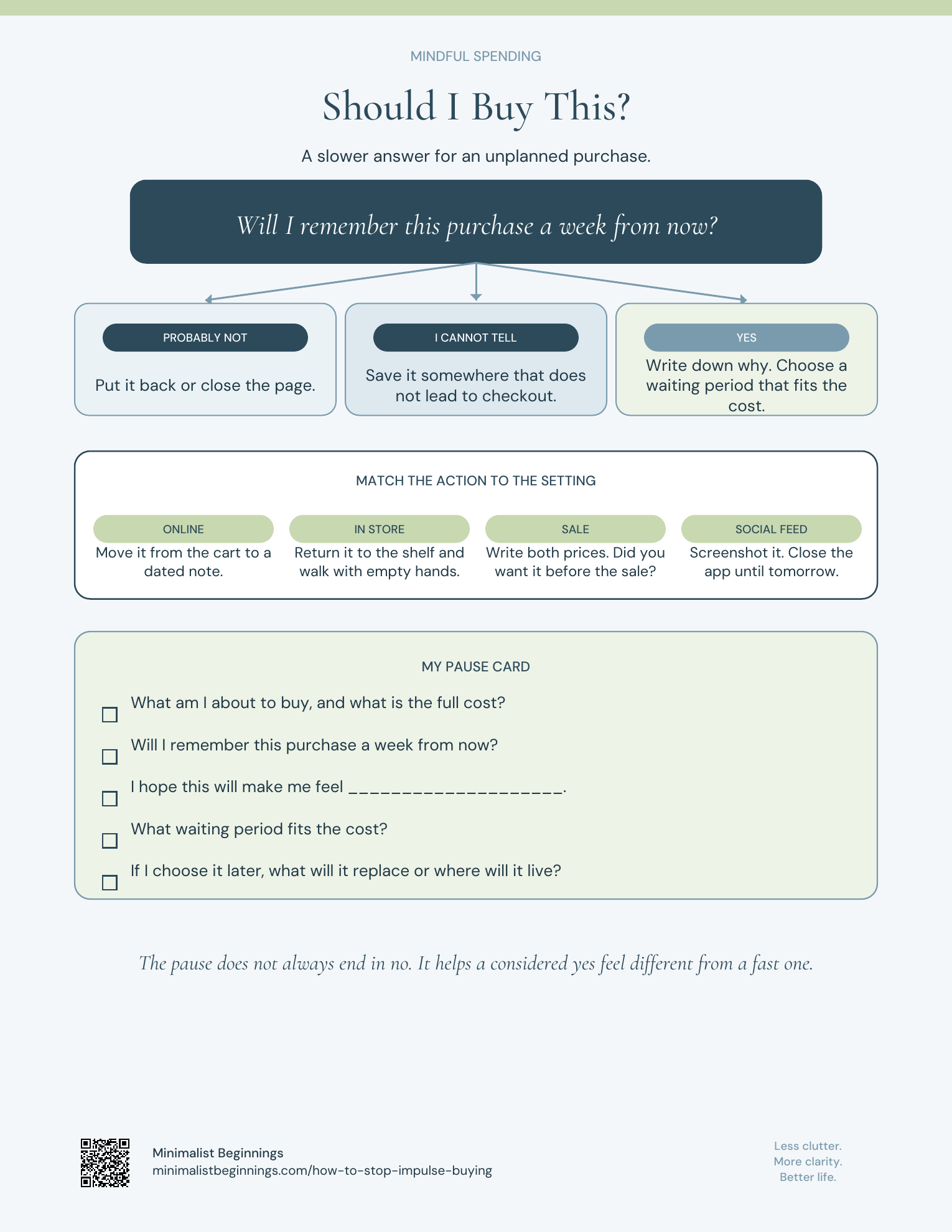
For seven days, record the purchases you pause. Do not score yourself. At the end of the week, notice which wants remained and which disappeared. You are collecting evidence about your own patterns, not trying to become a person who never buys anything.
Ordinary impulse purchases and compulsive buying are not the same. If buying feels uncontrollable, causes debt or secrecy, interferes with work or relationships, or creates marked distress, a pause card may not be enough. Research describes those consequences as signs that buying behavior may need professional attention. A therapist or qualified financial counselor can help you address the behavior and its effects without shame.
Continue with why you keep buying things you do not need when you want to understand the pattern. If a month-long boundary would teach you more than another one-purchase pause, use the no-buy challenge. The Mindful Spending hub holds the wider collection.
The next time an unplanned item asks for a quick answer, give it a slower one.