How to Make Your Home Feel Calm Instead of Chaotic
If your home doesn’t feel calm — if walking in feels like opening another tab of your to-do list — the work to make home feel calm again starts before you touch a single object.
When you walk through your front door, what do you feel? If the honest answer is stress — the mental list of things to tidy, fix, or deal with — something needs to change.
Your home is supposed to be the place where the outside world stops following you. For a lot of people, it isn’t. It’s another environment full of unfinished business.
A home that feels calm isn’t about having less stuff. It’s about having the right stuff in the right places — and nothing that shouldn’t be there.
Why your home doesn’t feel calm right now
If your home doesn’t feel calm, the issue is rarely a lack of the right furniture or decor. More often, it is the accumulation of small things asking for attention: a crowded surface, an unfinished task, a chair that has become a holding place. Each one is manageable. Together, they can make a room feel unsettled.
The visual noise problem
A room can feel busy before it looks messy. Every object in view adds detail, and too much detail can make it harder to settle. The aim is not an empty room. It is a room where your eyes have somewhere to rest.
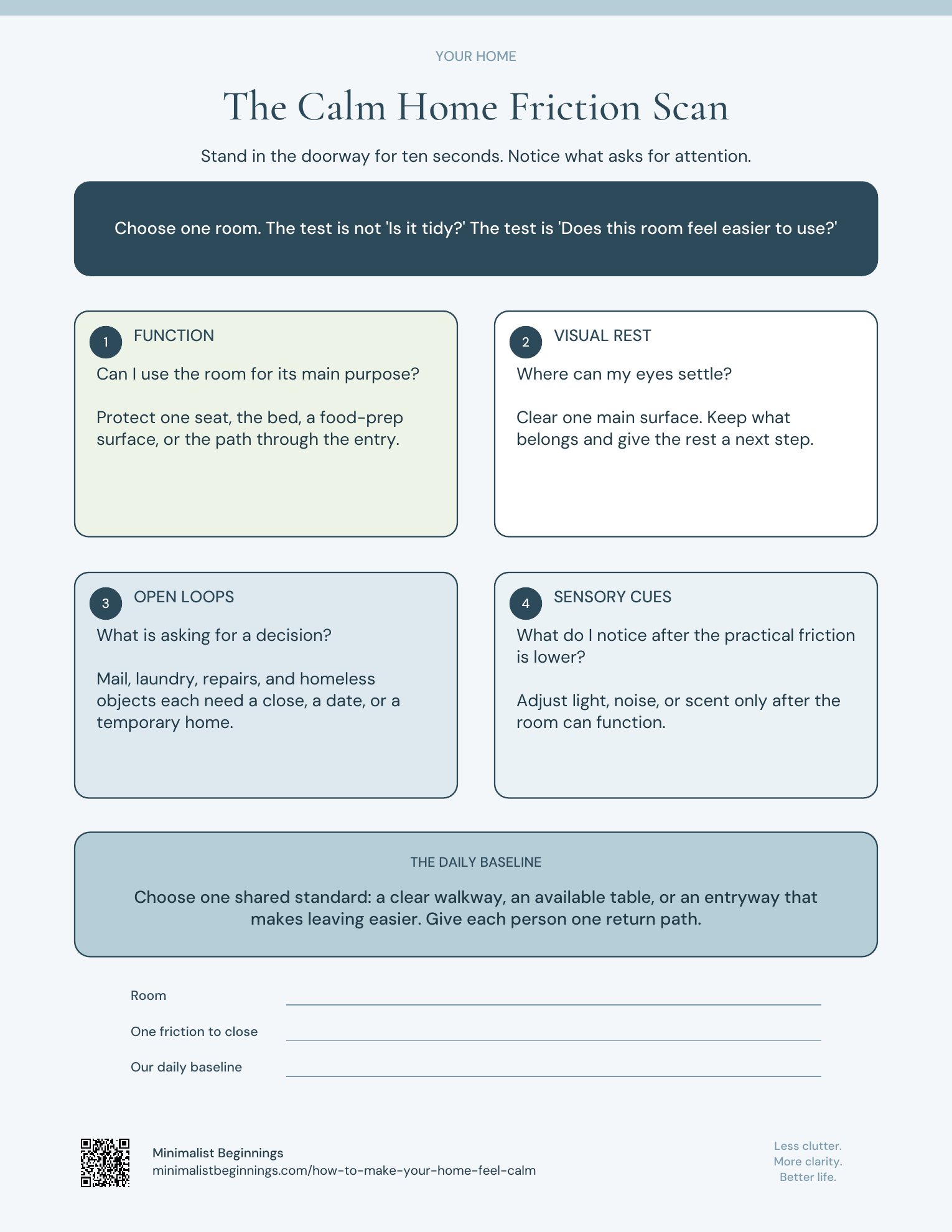
Stand in the doorway for ten seconds and notice what asks for a decision. A stack of mail asks whether it matters. A basket of clean laundry asks when it will be folded. A broken lamp asks whether it will be repaired. These are not decoration problems. They are unfinished decisions made visible. Choose one that can be closed today, then give the others a written next step or a temporary home.
Start with one room
Pick the room you spend the most time in — or the one that causes the most stress when you walk into it. That’s where to start. Not the whole house. One room, done properly. The goal: when you stand in the doorway, you should feel your shoulders drop. That’s the test. Not “is it tidy?” — “do I feel better in here?” If you don’t know where to begin, the work in how to start decluttering when you’re overwhelmed applies here too. Start smaller than feels reasonable. One surface. One drawer. The room comes together a little at a time.
The useful first move changes by room. In a living room, clear the seat you want to use and the path to it. In a bedroom, protect the bed and one nightstand from becoming holding areas. In a kitchen, keep one section of counter available for preparing food. In an entryway, make keys, shoes, and outgoing items easy to find. Calm begins where the room needs to work, not where a photograph would look polished.
The surfaces rule
Clear surfaces change how a room feels more than almost anything else. You don’t have to declutter your whole house — start by clearing the main surfaces. Countertops, coffee tables, the top of the dresser. Whatever’s on those surfaces either needs a proper home somewhere else, or it doesn’t need to be in the house at all. The kitchen counter is the one that matters most. It’s the most-used surface in most homes, and the one that telegraphs calm-or-chaos within seconds of walking in. Decluttering the kitchen is often the highest-leverage thing you can do for how the whole house feels.
Small visual changes with outsized effect
The fastest way to make a home feel calmer may be to change what you notice first. Softer evening light, less background noise, and one familiar scent can help mark the transition from a busy day to a quieter home. These changes are small, inexpensive, and personal. Keep the ones that make the room feel easier to be in.
Use sensory changes after the practical friction is lower. A lamp cannot make an overdue bill disappear, and a candle cannot give a homeless pile a place to go. Close the urgent decision first. Then use light, sound, and scent to mark the room as a place where the day can soften.
Maintenance over perfection
A calm home isn’t a one-time project. It’s a daily practice of putting things back, dealing with small messes before they become big ones, and being intentional about what comes through the door. Ten minutes a day beats a weekend blitz every month. The goal is a home that maintains itself — not one that needs rescuing. The other half of maintenance is what doesn’t come in. The one-in one-out rule is what keeps a calm home calm. The decluttering creates the relief. The inflow rule preserves it.
On a low-capacity evening, maintenance can be one return trip through the room. Carry dishes to the kitchen, clothes to the hamper, and objects with known homes back to those homes. Put uncertain items in one small basket for a steadier hour. Stop when the trip is complete. A shorter baseline is more dependable than a routine that works only on good days.
If you share the home, decide which baseline matters to everyone. It may be a clear walkway, an available table, or an entryway that makes leaving easier. Ask each person to own one return path rather than asking one person to notice every object. A calm home should reduce the household’s demands, including the demand placed on the person who usually restores it.
How to make home feel calm without copying Pinterest minimalism
A calm home doesn’t mean an empty home. It doesn’t mean a beige home. It doesn’t mean a home where the kids’ art has been replaced with framed prints from an online store. It doesn’t mean a home that looks ready for a magazine shoot at any given moment. Calm has nothing to do with aesthetic minimalism, and treating the two as the same thing is the most common mistake people make trying to copy this from social media. A calm home is a home where what’s there is what you chose, what’s visible is what you use, and the spaces breathe between things instead of being packed wall to wall. That can be Scandinavian-spare or it can be cottagecore-maximalist, and either one can feel calm. The shared trait is intention, not whiteness. If your version of calm includes a wall of books and a velvet armchair and a sleeping cat, that’s a calm home.
If you rent, making a rental feel like yours without buying more focuses on reversible changes to light, surfaces, and the rooms you use.
One thing to try this week
Pick the one surface in your home that bothers you most. Clear it — really clear it. Take everything off, deal with it, and only put back what genuinely belongs. Live with the empty surface for a few days. Notice what it feels like to walk past it. That feeling is the goal — and it’s available everywhere else in the house, one surface at a time.
To keep that calm from slipping, read the real reason your home gets cluttered again and why your entryway sets the tone for the whole house.
For more on creating a home that feels calmer and less cluttered, the Your Home guide covers every room.
Browse all your home posts or go back to all posts.