How to Simplify Your Life When Exhausted
The laundry needs moving, a message needs answering, and tomorrow’s list is already waiting. Even advice about making life easier can feel like another task.
When you are exhausted, begin by protecting what is essential and removing one optional demand. Choose a smaller version of what remains, ask for specific help where available, and stop before the reset becomes more work.
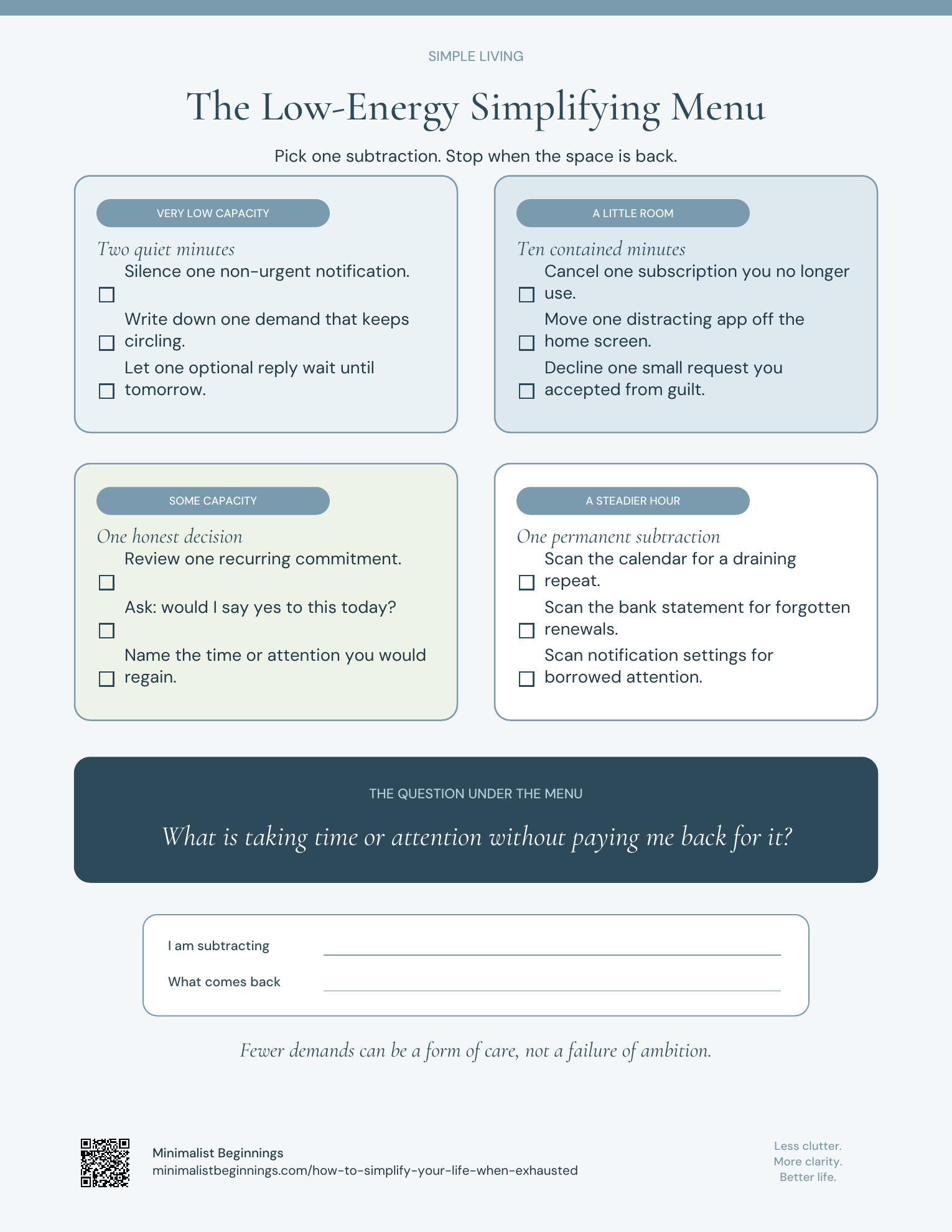
Download the free one-page Low-Energy Simplifying Menu (PDF).
You do not have to prove that your responsibilities are unimportant to need some relief.
Use five minutes to make the next part of today smaller
Exhaustion has many possible causes. Care responsibilities, demanding work, disrupted sleep, illness, grief, and financial pressure do not disappear because a list becomes shorter. You may be carrying important work with too little support.
The NHS guidance on tiredness and fatigue recommends medical advice when tiredness persists for weeks without a clear reason or affects daily life. A simpler routine can reduce demands, but it does not establish or treat the cause of fatigue.
The plan below is an optional way to reduce today’s load. Five minutes is a boundary, not a target to push through. You can do one step while seated, ask someone to help, or leave the exercise for another day.
- Protect the essentials. Name what genuinely needs attention soon: food, necessary medication, safety, care, or an unavoidable deadline. Keep this list short and specific.
- Remove one optional demand. Defer a nonurgent reply, skip an extra errand, or leave a decorative task undone. Choose something whose delay does not create a larger problem.
- Reduce or share one remaining task. Use an easier meal you have available, wash the items needed now, or ask someone to take one defined job.
- Stop. Put the note down. Do not turn the space you made into a new organizing session.
A useful result might be “food is covered, the extra errand can wait, and someone else is handling the pickup.” It does not need to look like a clear calendar.
Choose a smaller version before cancelling what matters
Some tasks are essential, but their usual version may be larger than today requires. Preparing food does not always require cooking from the beginning. Clean clothes do not always require finishing every basket.
Ask what the task must accomplish. If the purpose is having something suitable to wear tomorrow, focus on those items. If the purpose is staying in touch, a brief message may fit better than a long call.
Keep safety and care instructions intact. A smaller version should remove optional steps, not necessary ones. If you are uncertain about a care task, ask the appropriate professional or the person responsible for the care plan.
You can also change timing. A nonurgent administrative task may be easier during a steadier part of the week. Write one review date if needed, rather than carrying the reminder in your head all day.
Not everything deferred needs to return in its original form. When the date arrives, check whether it is still useful. You may choose a smaller version again.
Be selective about what you silence on your phone. A shopping alert can wait, while a care contact or work message you are required to receive may need to remain available. There is no need for an all-or-nothing digital reset.
Fit the plan to the responsibilities you actually have
These are illustrative situations, not reader case studies or treatment plans. Use the detail that fits and leave the rest.
When you are caring for someone else
A caregiver has an appointment to manage, food to arrange, and a pile of household paperwork. The appointment and immediate care stay. Sorting the entire paperwork pile waits.
The smaller step is putting the documents needed for the appointment together. A specific request could be: “Can you collect the groceries this afternoon and put the chilled items away?” That request names a whole task, including its finish.
If nobody is available, the next choice may be a smaller meal plan or postponing a nonessential errand. A lack of support is a real constraint. It is not evidence that the caregiver has failed to set a boundary.
When you work changing or late shifts
A shift worker comes home with limited energy and a daytime errand list. Their protected tasks are eating, preparing what the next shift requires, and leaving time for sleep.
The optional errand moves to another day. A nonurgent social reply becomes: “I have seen this and will reply after I have rested.” The household agrees which messages should interrupt that rest period.
The plan fits the person’s waking day rather than a conventional morning routine. There is no need to add an early start to qualify as organized.
When energy is unusually low
Someone has enough capacity for one small decision. They keep necessary items within comfortable reach and choose an available meal that requires little preparation. Sorting a drawer is not on today’s list.
If help is available, they can ask for a specific task, such as clearing a safe route through the room. If even the five-minute plan is too much, they can stop at identifying the next essential need.
Living with an ongoing health condition may require a different approach to activity. Follow advice that applies to your circumstances. This article does not ask you to extend activity or push through symptoms.
Ask for help with a task that has a clear finish
“I need more help” may be true, but a concrete request can make the next action easier to understand. Name the task, the timing, and what completion means.
For example: “Can you handle dinner tonight, including putting the food away?” Or: “Can you make the appointment call tomorrow and add the time to our shared calendar?” Choose wording that fits the relationship.
If the other person cannot help, you have information to work with. You can ask about another time, a smaller task, or a different source of support. You do not have to convert every refusal into doing the original plan yourself.
For recurring overload, a later conversation about responsibilities may be needed. That conversation can wait for a more suitable moment. Today, the aim is one manageable next step.
If rest feels like something you must earn, how to stop treating rest like a reward offers a related reflection. Rest does not need to follow a completed list.
Leave a stopping point instead of another project
Before you begin any small reset, decide what finished means. “Tomorrow’s clothes are ready” has an end. “Get the house under control” can expand until there is no energy left.
Keep loose items contained and walking routes clear. If you start a task and need to stop, return it to a safe state. A closed drawer or a contained stack of papers can wait for another session.
Do not fill every bit of time you recover. An optional demand removed from today does not need an immediate replacement. The relief may be small, and the day may still be difficult.
When you have more capacity for a wider review, the general guide to simplifying your life covers broader choices. For a contained physical task on a steadier day, starting a declutter when overwhelmed offers a separate plan.
For now, protect the next essential need. Let one optional demand wait. That is enough to begin.
Browse all simple living posts or go back to all posts.